Toe Touch Test: What It Reveals About Mobility and Control
Toe Touch Test: What It Reveals About Mobility & Control
If your toe touch feels tight, restricted, or inconsistent, it’s rarely just “tight hamstrings.” More often, it’s giving you information about how well your body coordinates hip movement, pelvic control, and spinal mechanics.
For golfers, limitations here usually show up as difficulty staying in posture, standing up early through impact, or inconsistent contact. For everyday athletes, it often feels like stubborn hamstring tightness, recurring lower-back stiffness, or that sense of always feeling stiff no matter how much you stretch.
What this test is really measuring
Although it looks simple, the toe touch reflects how your body moves as a system. It gives us information about hamstring and hip mobility, but also about pelvic control, spinal movement, and how confidently your nervous system allows you to hinge forward. When those pieces work well together, the movement feels smooth and controlled. When they don’t, the body often responds by tightening up for protection.
This is why two people can feel the same “tight” sensation at the bottom of a toe touch but need completely different solutions.
How to perform the test
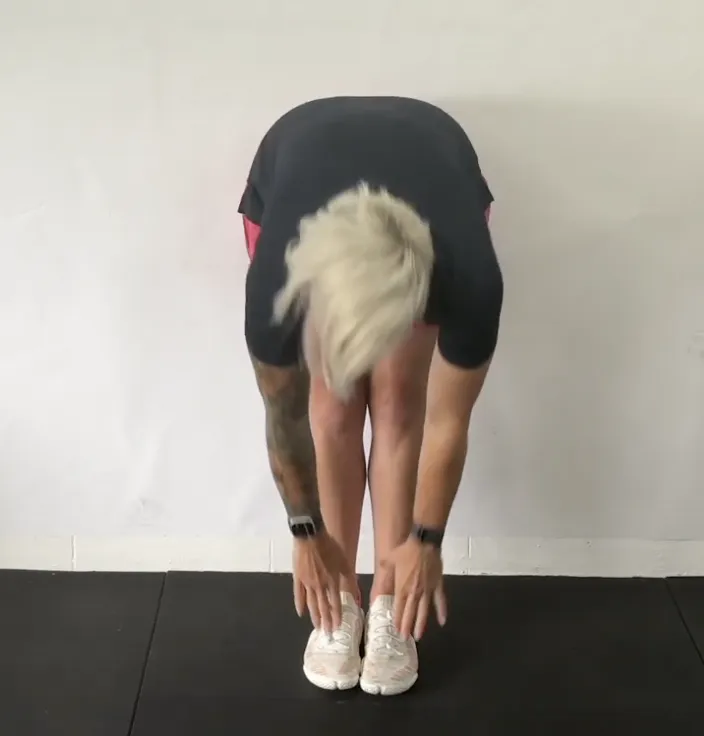
Stand tall with your feet together. Keep your knees straight then reach toward your toes. Let the movement happen naturally and avoid forcing depth.
What your result might be telling you
If you feel strong, consistent tension through the hamstrings, that may point to a genuine mobility limitation.
If your range improves when the movement is slowed or supported, it often suggests a control or stability issue rather than flexibility.
If your toe touch feels different day to day, your nervous system may be driving protective tension rather than tissue restriction.
This is why stretching alone doesn’t always fix the problem.
Corrective drill: Blocked Toe Touch
Placing a block, ball, or rolled towel between the knees adds stability to the hips and pelvis. When the body feels supported, the nervous system often relaxes its grip, allowing the hamstrings to lengthen more freely. The goal isn’t to stretch harder — it’s to move better.
Retest your toe touch after the drill and notice whether the movement feels smoother or more controlled. If nothing changes, that’s useful information too. It tells us the restriction may be coming from somewhere else, such as how your spine moves or how the pattern is controlled.
👉 Knowing the test is one thing — knowing how to apply it is another.
The free Swing Fit App gives you ongoing education, weekly tips, and practical challenges to help you build better movement habits.
